On a coastal house, fiber cement siding is usually the choice when fire resistance, rigidity and a painted, wood-like finish matter most; vinyl is the choice when low upkeep and a lighter, simpler installation matter most.
In salt air, heavy rain and hurricane season, either one performs only as well as the product line, the fastening and the layers behind it.
Much of what is said about both materials is half true. Below are the claims repeated most often, checked against what the manufacturers, the vinyl industry’s own association and federal data actually say.
The short answer
Neither material is a mistake on the Carolina coast. The real decision is about priorities: how the house should look up close, how much periodic upkeep you accept, how exposed the walls are to wind and spray, and how long you plan to own the home.
If you want painted boards with crisp shadow lines and a noncombustible skin, fiber cement fits. If you want color that is part of the material and a cladding you mainly rinse, vinyl fits, provided it is installed the way its industry specifies.
What new homes in the South are actually clad in
The two materials sit almost side by side. According to the Census Bureau’s 2025 Characteristics of New Housing, published in July 2026, fiber cement was the primary exterior wall material on 24% of the single-family homes completed in the South, and vinyl on 21%. Brick (26%) and stucco (23%) made up most of the rest.
Nationally the order flips: vinyl led with 26%, fiber cement followed with 23%. Among Southern homes built under contract for owners on their own land, the custom segment, stucco led with 30%, with fiber cement at 23% and vinyl at 22%.
Myth: vinyl never needs attention
Vinyl does not need paint, and that is a real advantage. But it moves. The Polymeric Exterior Products Association, formerly the Vinyl Siding Institute, notes that vinyl siding can expand and contract half an inch or more over a 12-foot-6-inch length as temperatures change.
That is why its installation guidance calls for fasteners centered in the nailing slots, panels left free to slide, gaps at openings and corrosion-resistant nails, staples or screws. Panels nailed tight cannot move, and that is when buckling and waviness show up.
On the coast, plan on periodic washing as well: salt spray, pollen and mildew collect on any siding, whatever it is made of.
Myth: fiber cement is maintenance-free because it is cement
The manufacturer describes the board as resistant to rot and of little appeal to pests, but what you see is paint. Paint and caulked joints are the maintenance items on a fiber cement house, and their life depends on the coating, its color and the sun and salt exposure of each wall.
Factory-finished boards and field-painted boards age differently, and so do south-facing and shaded walls. Ask for the paint system and its recommended maintenance in writing before you choose.
Myth: one fiber cement product suits every climate
James Hardie, a major fiber cement manufacturer, formulates its siding by region. Its HZ10 line is described as engineered for hurricane-force winds, the salty air of the coast and the humid heat of the South, while its HZ5 line targets freezing climates with snow and ice.
For a Lowcountry house, ask which product line is specified and why. The same question applies to vinyl: products in the industry’s VSI Product Certification Program are tested and validated by an independent, accredited certification body.
Myth: the siding is what keeps the water out
Siding sheds most of the rain, but wind-driven water still reaches the wall behind it. What protects the house is the layer underneath: the water-resistive barrier and the flashing around every window, door and roof intersection.
PEPA’s guidance for vinyl calls for flashing that meets ICC AC148 around openings, corners and the junction of walls and roofs, extended past the window nail flanges so water is directed outward. Fiber cement depends on the same layers. A carefully detailed barrier under either material matters more on the coast than the choice between them.
Myth: a fire rating settles the question
Fiber cement has a clear edge here. James Hardie states that its fiber cement products are noncombustible and/or carry a Class A fire rating under ASTM E84. The same statement adds a caveat: the fire resistance does not extend to paints or coatings, which can char.
Vinyl is a plastic (PVC) and is not sold on a noncombustible claim. Fire is one factor among several; for most coastal homes, wind, water and upkeep weigh at least as much in daily life.
Fiber cement and vinyl compared for a coastal house
| Question | Fiber cement | Vinyl |
|---|---|---|
| What it is | Cement-based boards, painted in the factory or on site | PVC panels with color through the material |
| Look up close | Painted boards, crisp edges and shadow lines | Depends on the profile and thickness of the product |
| Movement | Rigid | Expands and contracts; must hang free |
| Upkeep | Repainting and caulk over time | Washing; no painting |
| Fire | Noncombustible and/or Class A per the manufacturer; coatings excluded | No equivalent claim |
| Coastal product line | Climate-specific lines (HZ10 for hot, humid, salty, windy regions) | Certified products and installer programs through the industry association |
| Installation | Heavier boards, specialized cutting and handling | Lighter; fastening details are critical |
| What fails first if detailed poorly | Joints and paint | Panels that cannot move; loose panels in wind |
If you are building new, the cladding is one of the many decisions a builder makes for you when you buy a finished house; we compare that trade-off in custom home vs spec home.
Lap siding on a Charleston cottage
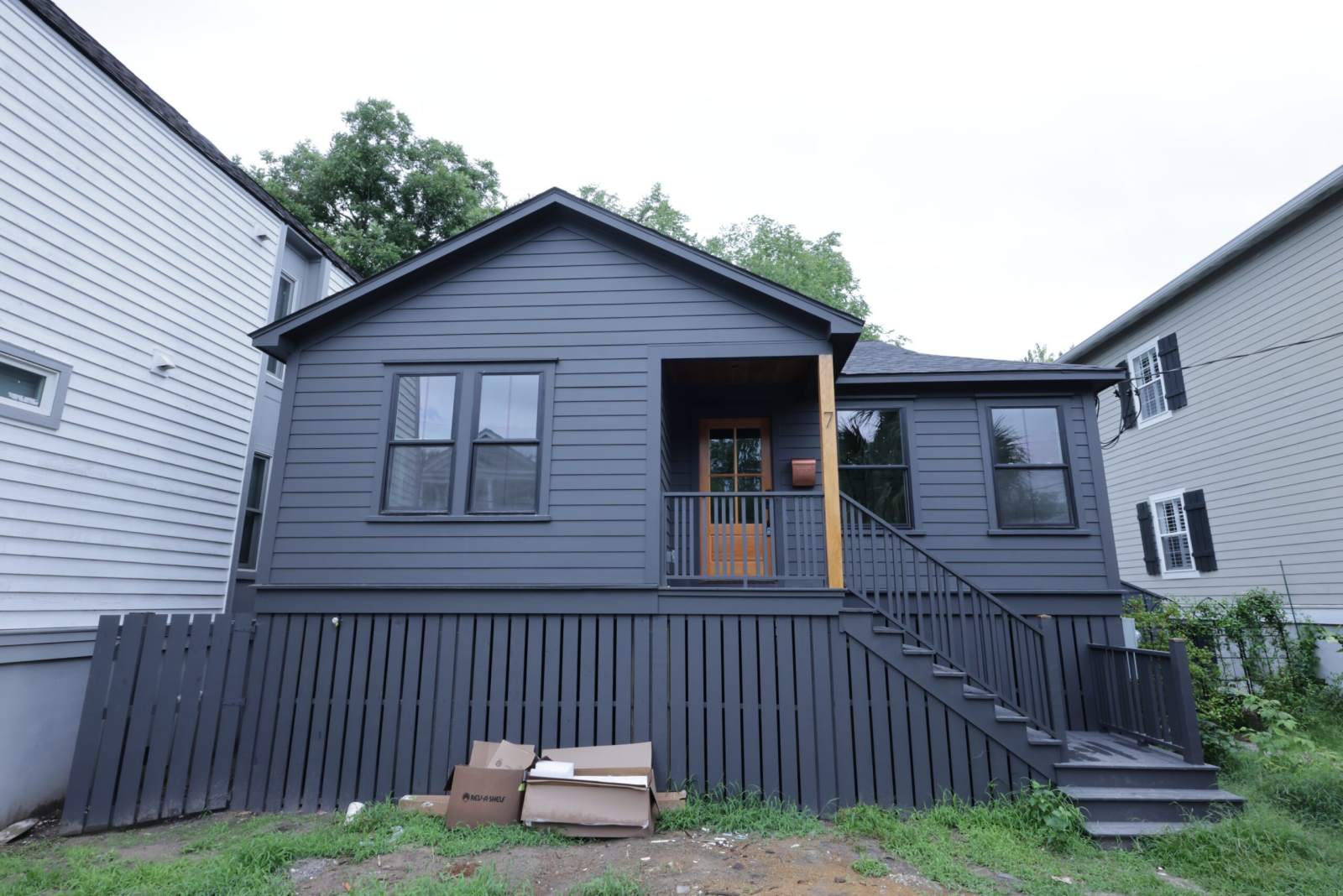
Material is only half of the look. Profile, exposure, color and trim decide how a house reads from the street. In our Downtown Charleston renovation, the exterior was reset in a deep charcoal lap siding with a natural-wood entry door, a restrained palette that holds its own among historic neighbors.
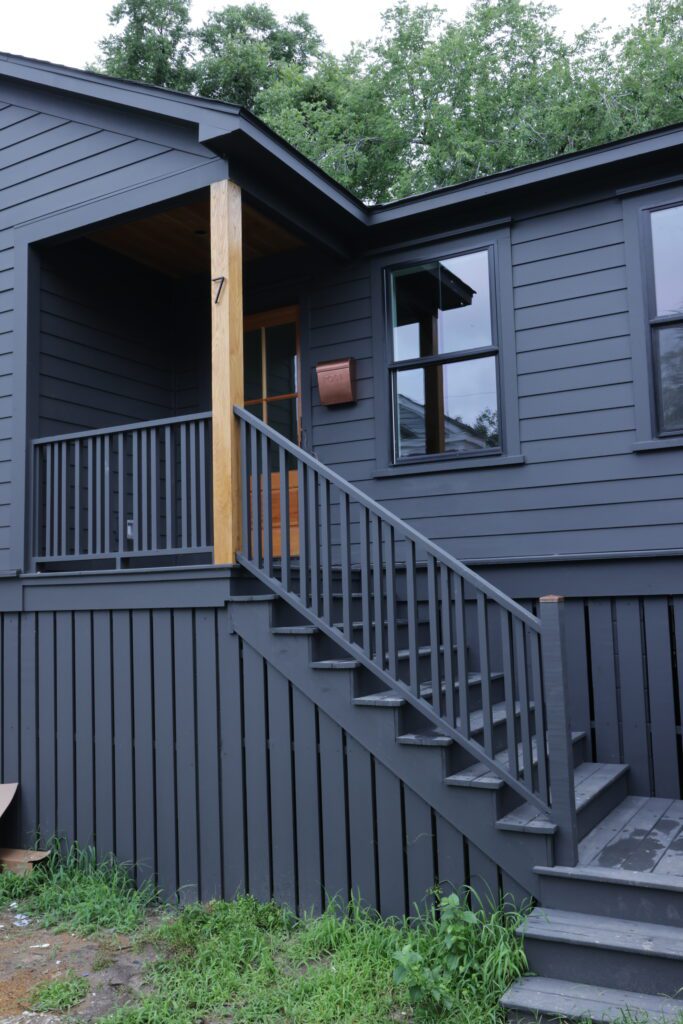
The photo shows what makes lap siding work on a small, older-style house: even reveals, simple flat trim around the windows, and a vertical board skirt that closes the space under the raised floor. The same discipline applies to fiber cement or vinyl; it is the installation that makes either one look intentional.
What decides the price of each
Siding is priced by the wall more than by the material alone. The factors that move a proposal are:
- the product line and thickness, and whether boards come factory-finished or are painted on site;
- the area of wall, the number of stories and how the house is accessed (an elevated house needs more staging);
- tear-off and repair of what is found underneath, in a residing job;
- the water-resistive barrier, flashing and trim details;
- the number of windows, doors, corners and transitions;
- the fastening the wind exposure requires.
A meaningful comparison prices both materials on the same wall, with the same barrier and trim details, in writing.
Coastal siding checklist to bring to your builder
- ☐ Which product line is specified, and is it intended for hot, humid, coastal climates?
- ☐ What fasteners are used, and are they corrosion-resistant as the manufacturer requires?
- ☐ What water-resistive barrier goes behind the siding, and how are windows and doors flashed?
- ☐ For vinyl: are fasteners centered in the slots, with panels free to move and gaps at openings?
- ☐ For fiber cement: what paint system is used, and what maintenance does it call for?
- ☐ How is fastening adjusted for wind exposure on this house?
- ☐ What does the warranty say about coastal exposure, and what voids it?
- ☐ Will exterior work be scheduled with the hurricane season, from June 1 to November 30, in mind?
How we approach cladding in the Lowcountry
At Domus Built, cladding is part of how a house stands up to the coast. We source and install standing-seam metal, premium architectural shingles and engineered cladding to perform in the salt air and storms of the Lowcountry, and we count salt-air detailing and hurricane fastening among the things that matter most when building here.
Whether you are building new or matching cladding on an addition, request a private consultation and we will walk through the options for your walls.