A Charleston County building permit is the written approval to start construction, issued by the county’s Building Inspection Services for properties in unincorporated Charleston County.
If the house sits inside a city or town, such as Charleston, Mount Pleasant, James Island or one of the island towns, the permit comes from that town’s own office, even though the address is still in Charleston County.
So the first step is not the application. It is finding out which office has your address; then whether the work needs a permit at all, which approvals come first, who signs, and which inspections close it out.
That first step changed for some homeowners this year.
Since May 1, 2026, new building permits and inspections in the Town of James Island are handled by the town through SAFEbuilt, while projects already under way stay with Charleston County Building Services, according to the town’s Building Services page. Applying at the wrong counter only sends you back to the start.
Step 1: Find out which office has your address
Start with the parcel, not the mailing address. A “Charleston” address can fall inside the City of Charleston, inside another town, or in unincorporated county land, and a single road can cross from one to the other.
The parcel record shows which jurisdiction the lot belongs to; if in doubt, call the office in the first row and ask before you prepare drawings.
| Where the house is | Who issues the building permit | How you apply | Worth knowing |
|---|---|---|---|
| Unincorporated Charleston County | Charleston County Building Inspection Services, 4045 Bridge View Drive, North Charleston | The county’s online Citizen Self Service (CSS) portal, linked from the Building Inspection Services page | Inspections are requested only through the portal or by email, not by phone. Zoning permits are a separate step with county Zoning & Planning. |
| City of Charleston (the peninsula, Daniel Island and parts of West Ashley, James Island and Johns Island) | City of Charleston Building Inspections, through the Permit Center at 2 George Street | The City’s Customer Self Service portal; forms are on the City’s Applications & Guidelines page | Residential work is split into application types: alterations and additions, decks, fences, foundations, roof repair or replacement, window and door replacement, demolition. Electrical, plumbing, mechanical and gas work are issued as trade permits. |
| Town of Mount Pleasant | Building Inspection Division, 100 Ann Edwards Lane | The town’s online permitting portal (OPAL), reached from the Building Inspection Division page | The town requires a permit to build, enlarge, repair, move or demolish, and to install or alter electrical, gas, mechanical or plumbing systems. |
| Town of James Island | The town, through SAFEbuilt, for permits applied for since May 1, 2026 | A Community Core account, set up from the town’s Building Services page | Work that started before that date continues with Charleston County. |
| City of Isle of Palms | The city’s Building Department | Through the city’s Building Permits page | The city says review of an application may take 4 to 6 weeks; renovation drawings must show what exists and what is proposed, with the signed owner–contractor contract and a Wild Dunes permit where it applies. |
| Town of Sullivan’s Island | The town’s own Building Department | Through the town’s Building Department page | The town’s own rule of thumb: if you are not sure whether work needs a permit, ask the building official. |
Summerville, Hanahan and Moncks Corner, which are also in our service area, sit mostly outside Charleston County, so the county office is not the one to call there. Start with the town.
Step 2: Check whether the work needs a permit at all
Most renovation work does. Section 40-59-265 of the South Carolina Code of Laws, in force since May 16, 2022, names a short list of home improvements that are exempt from building permit applications. Anything outside that list should be treated as permitted work until the local office says otherwise.
The exempt list, in short:
- A one-story detached accessory building of up to 200 square feet, which answers the common shed question.
- Fences up to 7 feet and retaining walls up to 4 feet that hold back no extra load.
- Sidewalks and driveways.
- Painting, papering, tiling, carpeting, cabinets, countertops and similar finish work.
- Decks of up to 200 square feet that are no more than 30 inches above grade at any point.
- Small electrical jobs: swapping a lamp, reinstalling plug receptacles, replacing a breaker of the same capacity in the same place.
- Stopping a leak or clearing a stoppage, as long as no pipe, valve or fixture is replaced or moved.
Read the plumbing line closely. Once a concealed drain or supply pipe has to be removed and replaced, the statute treats it as new work that needs a permit and an inspection.
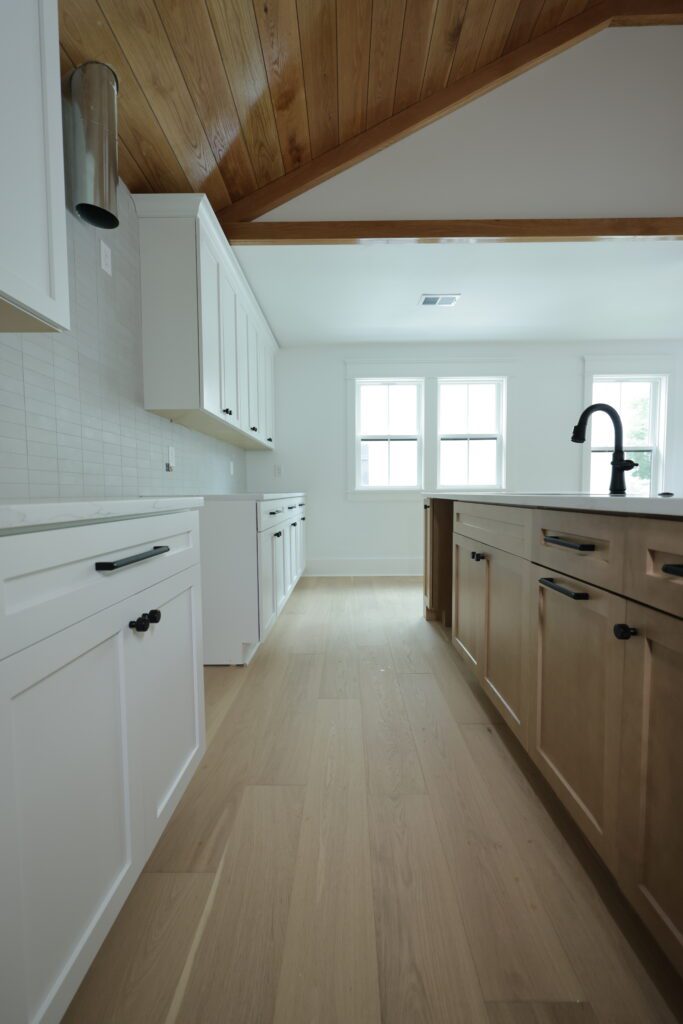
A quick test for everything else: if the work moves a wall, a pipe, a wire or a duct, changes the roof, or replaces windows and doors, plan on a permit.
In the City of Charleston, flood zones lower the bar further. Inside the Special Flood Hazard Area, a permit is required for all development, including storm-damage repairs to ductwork, flooring and roofs, as the City’s floodplain development rules spell out.
Step 3: Clear the approvals that come before the building permit
The building permit is usually the last approval, not the first. Depending on the lot, these come before it or alongside it:
- Zoning. Setbacks, height and lot coverage are checked by zoning staff; in unincorporated areas that is a separate county permit.
- Historic districts. In the City of Charleston’s historic districts, exterior work visible from the street goes to the Board of Architectural Review. The BAR’s own guidelines put zoning first, then the BAR, then the building permit.
- Flood zone. If improvements reach 50 percent of the building’s value, the house has to meet current flood rules. In the City, that test is cumulative over one year of permits, and the Substantial Improvement package is submitted during permitting.
- Trees and stormwater in Mount Pleasant. New homes, additions, decks, screened porches, pools and detached structures need a single-family stormwater management and tree preservation permit, applied for with the building permit; under the town’s Ordinance 18103, downspouts cannot discharge within 10 feet of a shared property line.
- Private approvals. A homeowners association or architectural review board may need to sign off first; Isle of Palms asks for the Wild Dunes permit with the application where it applies.
Decision point: if the house is in a historic district or a flood zone, settle those questions in design. Changing drawings after a plan review comment costs more time than drawing them right the first time.
Step 4: Decide who signs the application
State law expects residential construction to be done by licensed residential builders and specialty contractors, and in practice the licensed contractor applies for the permit and schedules the inspections. On our projects, permits, inspections and code-compliance paperwork are handled in-house by our own team.
An owner can act as their own builder under a narrow exemption in Section 40-59-260 of the same chapter:
- The owner must appear in person and sign the permit application.
- The house must be for the owner’s or the family’s own use. Selling or renting it within two years of completion is presumed to break the exemption.
- Anyone the owner hires must hold the licenses the work requires.
- The owner files a notice with the register of deeds stating the work was done as an unlicensed owner-builder.
The City of Charleston handles this through a Non-Licensed Owner Intent to Build form, which covers residential single-family permits except fuel gas.
Step 5: Plan the inspections that close the permit
A permit is not finished when it is issued. It closes when the required inspections pass, usually at the foundation, the rough-in of plumbing, wiring and ductwork, the framing, and the final walk-through. In a flood zone, new or substantially improved buildings also need elevation certificates at the stages the floodplain office sets.
Each office runs inspections its own way. Charleston County takes inspection requests only through its portal or by email, and the City of Charleston lets contractors and owners check the status of permitted inspections online. Permits also expire under the adopted codes if work stops, so a project that stalls has to be renewed before it can resume.
What decides how long the permit takes
No office publishes a single number for every project, and the drawings decide more than the counter does. What moves the timeline:
- Which office reviews it, and how busy it is. Isle of Palms, for one, tells applicants to allow 4 to 6 weeks.
- How complete the drawings are at submittal; review comments restart part of the clock.
- Whether zoning, the BAR, a flood-zone package or a tree permit has to come first.
- How many trade permits the work needs and how quickly inspections can be booked.
Permit fees in Charleston County and on Isle of Palms are calculated from the project’s declared value, so the scope you describe also sets the fee. Permits run alongside design, selections and orders rather than after them; our guide to how a whole-house renovation timeline fits together shows where they sit.
What unpermitted work costs the next owner
Charleston County is direct about this: unpermitted work includes renovations, remodels, additions and electrical or plumbing upgrades done without permits, and the current homeowner is liable for any fines, for demolition, or for retroactive permits to bring the structure into compliance. That warning sits on the front page of its Building Inspection Services site.
That liability follows the house, not the person who did the work. If you are buying, ask the seller for the permit history of any addition, enclosed porch or converted space under a raised house, and check it with the office from Step 1.
The simplest protection is to keep every permit and final inspection with the house papers. If your project is one of the renovation projects in Charleston County that needs more than paint and finishes, bring the address to the first conversation; the permit path is one of the first things we map. Plan your renovation with Domus Built.