Interviewing a custom home builder is closer to hiring a general manager for a year-long project than to shopping for a house. You are not choosing a finished product; you are choosing the people, the process and the paperwork that will produce one.
The questions to ask a custom home builder fall into five groups: license and insurance, who will do the work, how the contract handles money and changes, experience with Lowcountry flood and wind rules, and how communication and warranty work.
For each one, a good answer is specific, written down and something you can verify. Below are the questions, what a solid answer includes, and how to check it.
License and insurance: the answers you can verify the same day
- Are you licensed as a residential builder in South Carolina? Under what name and number?
- Can you send current certificates of general liability and workers’ compensation insurance?
- Who carries builder’s risk insurance during construction, you or me?
South Carolina law requires residential builders to be licensed by the state’s Residential Builders Commission, and a builder who is required to hold a license and does not cannot file a mechanics lien or sue to enforce the contract (S.C. Code §§ 40-59-30 and 40-59-220).
Look the license up yourself on the SC Department of Labor, Licensing and Regulation website, and check that the name on the license matches the name on the contract.
Who will actually be on your site every day
- Which trades are your own employees, and which are subcontracted?
- Who is my day-to-day contact, and who runs the site when that person is away?
- How many homes will you be building while you build mine?
There is no single right model. Some builders run their own crews, others manage trusted subcontractors, and both can produce good homes. What matters is that the answer is clear and that one person is accountable for the site every day.
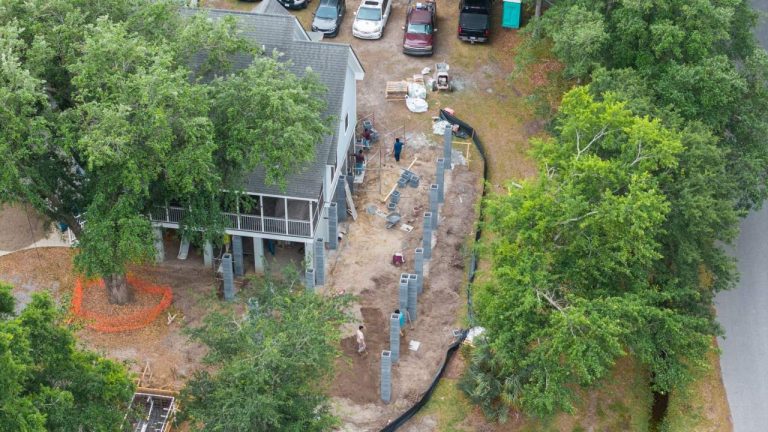
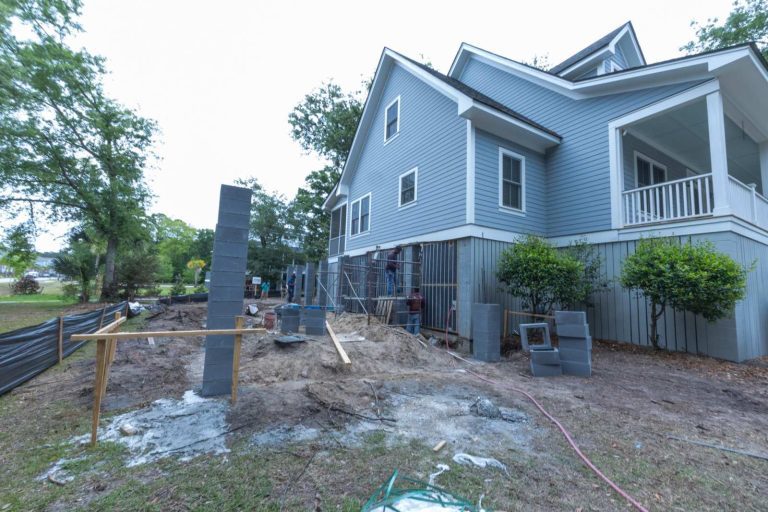
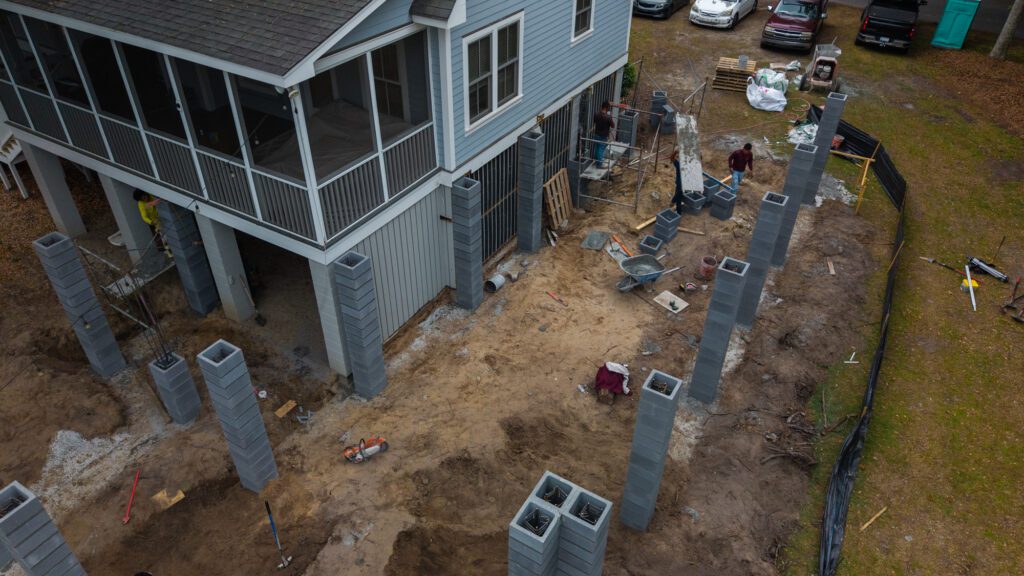
Ask to visit a home in progress, not only a finished one: a tidy, organized site says more than a portfolio.
Contract, allowances and changes: where budgets usually slip
- Is the contract fixed-price or cost-plus, and what exactly is included?
- Which items are allowances (tile, plumbing fixtures, appliances, lighting), and how were those amounts set?
- How are change orders priced, approved and documented before the work happens?
- What is the payment schedule, and what milestone triggers each payment?
- When is the final payment due, and what has to be finished first?
Allowances are the quiet source of overruns: an allowance set below what your selections will cost turns into a change order later. Ask to see a sample proposal with the allowances listed line by line, and a sample change order. If the builder cannot show you the form they use, there probably is not one.
Lowcountry questions most checklists leave out
- How many homes have you built or renovated in FEMA flood zones, and who sets the floor height?
- What foundation do you expect on my lot, and why?
- How do you handle hurricane connections and salt-air corrosion?
- Who pulls the permits and schedules inspections?
- Have you taken a project through the review board my lot falls under (the city’s Board of Architectural Review, or a community’s architectural review board)?
- How do you protect large trees during construction?
Good answers here are specific to the place. In the City of Charleston, for example, new homes in the flood zone must be designed 2 feet above the base flood elevation (City of Charleston, Floodplain Management).
In the City’s Coastal A Zone, homes must stand on pile, post, pier or column foundations, and elevation certificates signed by a South Carolina land surveyor are required during and after construction (City of Charleston, Coastal A Zone guidance). A builder who works here should mention requirements like these without being prompted.
Schedule, communication and warranty
- Can I see a sample schedule from a home like mine, and how do you report progress against it?
- How often will I get updates, and in what form (meeting, written report, photos)?
- What does your warranty cover, for how long, and how do I file a claim?
- How is the punch list handled before the final walkthrough?
Ask about defects too. South Carolina’s Notice and Opportunity to Cure Construction Dwelling Defects Act requires a homeowner to serve a written notice of claim on the contractor at least 90 days before filing suit.
The law gives the contractor 30 days to inspect, offer to repair, offer to settle or deny the claim (S.C. Code §§ 40-59-840 and 40-59-850). A builder who explains how they respond to warranty calls is telling you how that process will go.
Red flags in the answers
- A license number that is vague, under another name, or “in process.”
- No written change-order process, or “we’ll sort it out as we go.”
- Allowances that look low next to the finishes you described.
- Reluctance to share references or let you visit an active site.
- Pressure to sign before you have read the full contract.
- Payment schedules that run well ahead of the work in place.
Printable interview sheet
Print this table and use one copy per builder. The right column is the part most people skip.
| Ask | A good answer includes | How to verify |
|---|---|---|
| South Carolina residential builder license? | Exact name and license number | State license lookup; name matches the contract |
| Insurance? | General liability and workers’ compensation certificates | Certificates sent by the insurer or agent, with current dates |
| Who builds it? | Which trades are in-house, who the site lead is | Meet the site lead; visit an active site |
| Contract type? | Fixed-price or cost-plus, with what is included | Sample contract |
| Allowances? | Each one listed, with how it was set | Sample proposal; compare with your selections |
| Changes? | Written change orders approved before work | Sample change-order form |
| Flood and wind? | Floor height, foundation type, connections for your lot | FEMA flood map; city or county floodplain office |
| Permits and reviews? | Who pulls them; review-board experience | Permit history of past projects |
| Communication? | Frequency and format of updates | A real progress report from a past project |
| Warranty? | What is covered, for how long, how to file | Written warranty document; references’ experience |
Our answers, for comparison
If you are interviewing us, here are the commitments we publish, so you can hold us to them. Domus Built is licensed in South Carolina and carries general liability and workers’ compensation insurance. We do not subcontract our crews: the people on site are our own team, with one foreman accountable every day.
Permits, inspections and code compliance are handled in-house. Proposals itemize the scope and disclose material allowances, and change orders are documented before the work. Clients get weekly progress reports with photos, and final payment is released only when the home is complete to their satisfaction.
We take on a limited number of projects each year and work with your architect or recommend one.
Ask us for the paperwork behind each of those statements, and look at our recent projects. If you are earlier in the process, our post on what to know before building a custom home in Charleston covers budget and financing first.
When you are ready to compare builders for custom homes in Charleston, bring this sheet to your first meeting with us. Schedule a consultation with Domus Built.